Alzheimer’s disease is estimated to affect nearly seven million Americans. While the precise causes and potential cure for Alzheimer’s remain central mysteries in medical research, significant progress is being made toward innovative treatments. Early detection of Alzheimer’s disease is essential, as it opens the door to advanced treatments, vital resources, and supportive communities.
Symptoms such as memory loss and confusion are not exclusive to Alzheimer’s disease; they may also point toward other underlying health conditions. Carolinas Imaging Services supports your healthcare provider by offering advanced imaging technologies, including CT scans and MRI scans, as well as subspecialized expertise from fellowship-trained neuroradiologists to accurately diagnose Alzheimer’s disease and explore other potential diagnoses.
What is Alzheimer’s Disease
Alzheimer’s disease is a progressive brain disorder that leads to a decline in cognitive functions such as memory, thinking, and reasoning. It is the most common form of dementia, affecting primarily older adults. The disease is characterized by:
- Buildup of abnormal proteins called amyloid plaques and tau tangles in the brain
- Disruption of communication between neurons, where brain cells have trouble sending messages to each other
- Gradual cell degeneration, with brain cells slowly breaking down over time
What Part of the Brain Does Alzheimer’s Affect First?
In the early stages, Alzheimer’s disease primarily affects the hippocampus, the part of the brain that is crucial for memory formation and spatial navigation. As the disease progresses, it spreads to other parts of the brain, which are responsible for higher cognitive functions such as reasoning, judgment, and language.
This initial impact on the hippocampus is why memory loss and confusion are often the first noticeable symptoms of Alzheimer’s disease. Understanding which areas of the brain are affected can provide insight into the nature of cognitive decline and assist healthcare providers in making accurate diagnoses and developing effective treatment plans.
Symptoms of Alzheimer’s Disease
Early symptoms of Alzheimer’s disease typically include forgetfulness and confusion, with challenges intensifying over time. As Alzheimer’s disease advances, it can significantly impact daily life and behavior, prompting changes such as anxiety and difficulty recognizing loved ones.
The early signs of Alzheimer’s can include a variety of cognitive and behavioral changes:
- Asking the same questions repeatedly
- Confusion regarding time or specific places
- Difficulty performing tasks during work or social activities
- Forgetting information shortly after reading it
- Misplacing items
- Mood or personality changes
- Poor judgment
- Problems with planning or organizing activities
- Struggles with judging distance while driving
- Trouble recalling the correct name or word
- Withdrawal from activities that were previously enjoyed
Many of these symptoms can be caused by other, potentially more treatable health conditions. These alternative causes may include medication side effects, urinary tract infections, or specific vitamin deficiencies. If simple explanations cannot account for the cause of these symptoms, a provider may recommend medical imaging.
While there is no cure for Alzheimer’s disease, treatments are available to manage symptoms, and ongoing research aims to find better therapies to improve the quality of life for those affected.
What Age Does Alzheimer’s Start?
Alzheimer’s disease is a progressive neurological disorder that primarily affects older adults, but its onset can vary significantly among individuals. While most people diagnosed with Alzheimer’s are over the age of 65, early-onset Alzheimer’s can occur as early as one’s 30s or 40s. This form of the disease is relatively rare and accounts for a smaller percentage of all cases.
Research indicates that age is one of the most significant risk factors for developing Alzheimer’s. The likelihood of being diagnosed with the disease approximately doubles every five years after the age of 65. By the time individuals reach their 85th birthday, a little over one-third may show signs of Alzheimer’s or other related dementias.
How to Tell If You Have Early-Onset Alzheimer’s
A diagnosis of Alzheimer’s disease or other forms of dementia is comprehensive, relying on a combination of factors. Your provider will assess your medical history, perform physical examinations, conduct laboratory tests, and review any changes in daily behavior to evaluate potential dementia. Getting screened at the first indication of Alzheimer’s disease symptoms is beneficial because it helps you receive timely treatment for other underlying conditions that might be causing the problems.
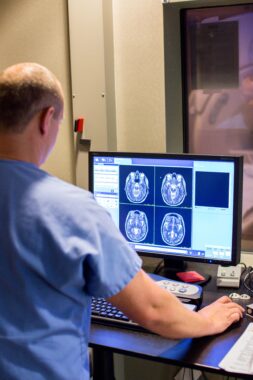
Imaging plays a critical and increasing role in this diagnostic process, specifically in ruling out alternative diagnoses. Many conditions present symptoms similar to dementia, but can be diagnosed with advanced imaging. For example, CT imaging can show conditions such as brain bleeds (hematoma), tumors, or stroke, which could be the true cause of changes in memory and behavior. Similarly, an MRI scan may be used to identify signs of other types of dementia.
Early detection offers several key benefits:
- Improved access to support: Receiving a diagnosis early means you and your family can begin planning for long-term care and accessing necessary resources.
- Starting treatment earlier: Although there is currently no known cure for Alzheimer’s, if the disease is caught in the early stages, new treatments or clinical trials may be beneficial.
Once a diagnosis and treatment plan are established, brain imaging techniques may be used subsequently to monitor the progression of the disease and the effectiveness of treatment.
The Importance of Imaging in Detecting Alzheimer’s
Imaging is critical when diagnosing Alzheimer’s because it provides physicians with detailed, non-invasive internal views of the brain that help differentiate between normal age-related changes, early Alzheimer’s disease symptoms, and other treatable conditions. When the symptoms of cognitive decline cannot be explained by simple factors, diagnostic imaging becomes essential for obtaining further clarity.
Carolinas Imaging Services (CIS), a joint venture between Charlotte Radiology and Atrium Health, provides accessible, high-quality outpatient imaging solutions for patients requiring diagnosis of Alzheimer’s disease. Our board-certified, subspecialized radiologists are experts in reading complex imaging scans, making sure that you and your provider receive precise, reliable results.
Specific Types of Scans for Diagnosing Alzheimer’s Disease
Two primary advanced imaging modalities are frequently used when assessing patients with potential Alzheimer’s disease symptoms: computed tomography (CT) scans and magnetic resonance imaging (MRI) scans.
CT Scans
CT is an advanced X-ray technology that creates detailed internal images of the body, including the internal organs, bones, soft tissues, and blood vessels. Head CT scans are frequently the first choice for diagnostic imaging when a head condition or injury is known or suspected.
For Alzheimer’s assessment, CT scans are capable of detecting structural brain changes that may be indicative of the disease. CT scans can also rule out other severe conditions that mimic dementia or cause cognitive changes, such as brain bleeds (hemorrhage), tumors, or stroke.
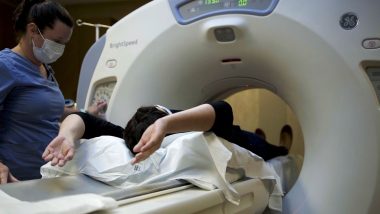
Memory changes and abnormal behavior can be symptoms that lead a provider to order a head CT scan, a diagnostic tool that can help providers look for changes in the brain specific to different types of dementia. A CT scan of the head typically involves lying on a table that slides into a doughnut-shaped opening. The machine rotates to capture pictures from all sides, which a computer then combines into a 3D view. A key advantage of CT scans is their speed, which is beneficial in urgent diagnostic situations. CT scans can generally take ten minutes or less, compared to the longer duration of an MRI.
MRI Scans
MRI technology uses radio waves and a strong magnetic field to produce detailed pictures of the body’s internal structures. MRI is particularly valuable because it captures clear, detailed images of soft tissues, including the brain, nerves, and organs. While CT scans are fast, MRI scans can often provide more detailed images to help better characterize a concern.
In diagnosing conditions like Alzheimer’s, MRI scans can show common signs of cognitive impairment. Specifically, MRI is highly effective for identifying cerebral microbleeds, which are tiny areas of bleeding within the brain’s blood vessels. These microbleeds are associated with cognitive decline, and their presence can help providers rule out other conditions as the cause of symptoms. If a provider suspects a condition like multiple sclerosis (MS), an MRI is also useful, as it can detect lesions or other changes in the brain due to MS progression. An MRI scan typically takes longer than a CT scan, averaging 30 to 60 minutes.
Partnering for Early Detection and Accurate Results
November is recognized as Alzheimer’s Disease Awareness Month. Early detection and diagnosis of Alzheimer’s disease has a significant impact, allowing providers to monitor disease progression through brain imaging techniques and enabling patients and families to engage in long-term planning.
Choosing a medical imaging provider is like choosing a doctor, and at Carolinas Imaging Services, we understand that getting a diagnosis is an important step on your journey to care. Our board-certified, subspecialized radiologists are experts in their field, providing accurate and timely results to your physician. We are committed to providing precise imaging in a convenient outpatient setting, allowing you to get the answers you need.