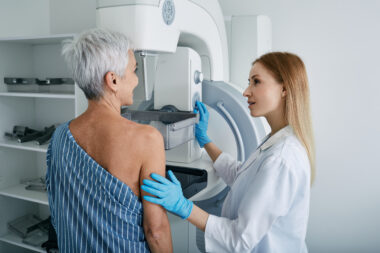
For Emily “Breeze” Watson — a CrossFit competitor, Reebok trainer, former D1 athlete, and dedicated mom of four — turning 40 was more than just a milestone; it was a call to action. While she is used to the high-intensity world of elite fitness, she took on a different kind of challenge: her first 3D annual screening mammogram. During this visit, Emily learned a vital piece of information about her health that affects nearly 50% of women aged 40 and older: she has dense breast tissue.
By sharing her story, Emily aims to demystify breast density and empower other women to discover how their breast tissue makeup influences their long-term breast health.
“It’s important to trust the place you are going to for these screenings to help you with the education about dense breasts, not just going down a ‘rabbit hole’ on the internet,” Emily says. “Understanding breast density correctly with the right education helps you navigate what the best next steps are.”
The Moment of Discovery
Breast density is a measure of the ratio of glandular and connective tissue to fatty tissue in the breast. It cannot be seen or felt during a breast self-exam; only a mammogram can allow radiologists to identify and categorize it.
Emily entered her mammogram appointment with a unique advantage: awareness of her family history, which had prepared her for the possibility of dense breast tissue.
“Walking into my appointment and getting my first mammogram, I had an idea of dense breasts because my mother and my grandmother had both been told that they had that during their mammograms,” Emily recalls.
Having researched the term in advance of her screening, the news wasn’t a shock. Emily was able to buffer the feelings with the knowledge and awareness of breast density.
“I thought that it could be a potential, considering my mother and my grandmother,” she explains.
Challenges of Breast Density
Learning about breast density is crucial because it affects imaging results. On a mammogram, dense glandular tissue appears white, but so do breast cancers. This effect can cause subtle changes or abnormalities in breast tissue to ‘hide,’ making them harder to detect, especially in the earliest stages.
Emily was quick to grasp the implications of this for her own health.
“When I’ve read about breast density, and talking with my mom and grandmother, I learned that it’s potentially a little harder to detect,” Emily says.
This realization served as a cornerstone for her advocacy. For Emily, the education she received from the team at Charlotte Radiology was paramount, especially regarding supplemental screening options like Automated Breast Ultrasound (ABUS), Breast MRI, and Abbreviated Breast MRI.
“I now understand that I might have to get more screenings during the year,” she notes. “Awareness is key for me. Going forward, each year as I age, I am free to go about my normal annual screening schedule, but may have other screenings during the year and need to keep an eye out for any changes.”
Overcoming Anxiety With Facts and Expert Care
Many women avoid screenings due to a fear of discomfort, pain, or the unknown. Emily was no different.
“As somebody who is under 40, you always hear of people who go in and have to get these screenings done, and people say that they’re uncomfortable or it’s awkward,” she admits.
However, the reality of the appointment was a pleasant surprise.
“It could not be further from the truth,” she explains. “I find it to be so easy and so comfortable. I feel very at ease. There’s no pain; it just feels like I’m doing a really good thing for my health.”
It’s important to dispel the myths about screenings and dense breasts, too, as many women worry unnecessarily about their health. With the support of a trusted partner like Charlotte Radiology, you can gain clarity and reassurance about your screenings and overall health.
“If you go on a web search or go down different paths, some of that information can be skewed or might lead you to worry,” Emily says. “Having a place like Charlotte Radiology can provide you with that comfort that you aren’t the only one, and there are plenty of people who have dense breasts.”
Advocating for Wellness: #HealthIsWealth
Emily often uses the hashtag #HealthIsWealth to remind her followers that their well-being is one of their most important assets.
“It felt important to me, as a woman here in Charlotte, to share my journey and share my experiences to hopefully help other women become comfortable with thinking that their health needs to come first, and that they need to take care of themselves.”
This philosophy drives her to advocate for other women to prioritize their screenings.
“I need to make these appointments so that I can be there for my kids, family, the things I love,” Emily says. “I wanted to be able to have that voice to tell women to get their yearly mammograms.”
And that voice allows her to connect with a community of women who share similar thoughts and aspirations. By discussing her experiences, Emily empowers others to take charge of their health and emphasizes the importance of accessing resources and support. “I have a strong relationship with my community and close circle, so being able to say that I have dense breasts to them and talk about it was very valuable and important to me.”
“It just makes me want to use my platform to share with other women how important it is to not only get your screenings, but to find a breast imaging center that you feel comfortable with,” Emily says. “Charlotte Radiology has been that for me. It’s been amazing for me, and I want to shout from the rooftops for everyone to stay on top of their health and make it a priority.”
Her message to any woman who is still fearful is one of empathy and responsibility.
“I’d reassure her that being fearful is normal, and probably the majority of us feel that way,” Emily says. “But she may have a spouse, children, or parents — all these people who love and count on her,” she says. “It’s important to take care of yourself first so you can be there for the people in your life who need you.”
A Partnership for Peace of Mind
Beyond the technology, Emily’s experience was defined by the compassion of her breast health team.
“The staff at Charlotte Radiology makes it easy and comfortable,” Emily says. “You’re educated and aware of any next step that’s going to occur from the moment you walk in, so you know what’s going to happen. You’re going to go in and get changed, see the machines, and the technologist will walk you through every single step prior to it happening. I think that helps all of us know what’s going to happen next.
A major factor in her comfort was her relationship with her mammography technologist, Rebecca Marsee.
“She is fabulous,” Emily says. “I absolutely love her. I just feel like she’s like a friend that I don’t see all the time, but when I go in there, it’s so easy to pick up and communicate with her.”
Rebecca — a breast cancer survivor herself who understands the anxiety of the process firsthand — shared her own story during the exam, which helped Emily feel supported. Learning about Rebecca’s journey was transformative. Becca’s authenticity helped Emily feel at ease, turning a clinical appointment into a proactive step for her health.
“For her to be so raw and authentic and real, it helps you put your guard down,” Emily says.
Emily’s Final Advice: Take the Step
For those nearing 40 or anxious about their results, Emily encourages women not to let the fear of density or discomfort hold them back.
“Make the phone call,” Emily urges. “Make the appointment. Just do it. Take that step forward. Get a buddy to go with you that’s in your circle and make appointments at the same time so that you can communicate through it all.”
Choosing a specialized breast imaging center like Charlotte Radiology ensures you receive high-quality, complete care from experts who focus specifically on breast health. Our board-certified, subspecialized radiologists are trained in mammography and breast procedures, and our all-female technologists are skilled in delivering compassionate clinical care so that women with dense breasts can receive the most accurate interpretation of their images and more personalized care.
“If you have questions, they stop and listen to you and respect you — same with the results and after the appointment,” Emily says. “They go over everything with you and make you feel at ease.”
In the journey of health, bravery leads to empowerment. As women support one another, they create a stronger community that fosters awareness and resilience.
“Any little bit of discomfort you might feel walking into it or during the appointment is worth everything to know what’s going on inside of your body,” Emily says. “It’s crucial to have somebody who can hold your hand through it all.”
Emily’s final advice radiates optimism and highlights the importance of connection and community.
“We build through community, and we lean on community when there’s good and bad. It’s important to have people to push you to make the appointments, process the information you receive, and then walk along with you.”